
Stowaways
Famous Visitors for the wrong reason
I’m afraid these three are stowaways. Ah, blast! This won’t look good in my report.{a}
⏱ QUICK READ
The vast majority of people get here by legitimate means; but some do not. This page records some of those whose attempt to get here was not exactly proper…
What are ‘Stowaways’?
A Stowaway is a person who secretly boards a vehicle (ship, aircraft, train, truck or bus). They are an inevitable part of being a sea port, but official records of them are hard to find. Ship operators certainly don’t want to admit that they carried them, and Governments largely don’t want too much attention given to these unwanted arrivals, if only because it is easier to remove them under a degree of secrecy. For example, if someone manages to get here and, upon arrival, makes a formal Claim of Asylum there are international rules governing how they must be treated, but if they make no such formal claim they can be easily deported.
This being the case, a section on Stowaways is hard to research, but here are a few titbits we have discovered.
SEE ALSO: People on this page tried to arrive at St Helena by unofficial means; those who tried to leave by unofficial means are in the page Escape!.
Known examples
Below: Discussion on Facebook™ in 2026 From the newspaper, July 2002 From the newspaper, June 2010 From The Records From The ‘Blue Book’ Others
A discussion on Facebook™ in 2026
The discussion centered on what stowaways to St Helena people remembered. Here are some of the comments made:
1980s & 90s
The most famous recorded incident fitting this description occurred in 1999{1} (with similar incidents also documented on the earlier vessel in 1984 and 1988{2}). In these accounts, stowaways managed to slip aboard during port stops in Cape Town, hiding in the cargo holds or void spaces and surviving during the multi-day Atlantic passage{3} by sneaking into the ship’s galley and dining facilities at night to take fruit, bread, and provisions before being discovered by the crew prior to docking.
We would like to know more about these. If you can add information please contact us.
Alain Hakizmana
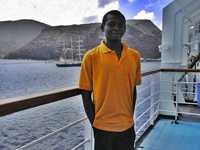
Alain Hakizmana, from Burundi
In March 2000 a 16-year-old Burundian refugee named Alain Hakizmana (photo, Radio St Helena interview, and BBC World Service feature, right) was discovered hidden in the top of the ship’s funnel.
I’ll never forget the Burundian guy and remember people saying how excited he was when he got in the only bath on the ship, to be cleaned by crew members.
You can read more in the St Helena News of 17th March 2000Ⓘ. Alain was subsequently allowed to enter the UK as a refugee.
From the newspaper, July 2002
Isaac Vunjauwd
25-year-old Isaac Vunjauwd, a Hutu, is originally from Burundi; he lost his father and brother in the 1992 war between the Tootsies and the Hutus. He then spent 8 years of his life in a refugee camp in Kingoma Tanzania with his mother and sister. Isaac eventually left his remanding family and travelled to Johannesburg where he lived for 18 months. However he kept moving until he made his way to Cape Town. It was here that he saw the word, ‘London’ painted on the stern of the RMS St Helena. Probably knowing that his only chance of creating a better life for himself would be in a country such as Britain he boarded. With the aid of a security guard, who provided him with a hard-hat and boiler suit, Isaac walked across the gangway with the other workers unsuspected. He then made his way to No 2 hatch where he hid under a car for the journey to St Helena.
Isaac was not found during the drill-check, which is done before leaving port because he had firmly positioned himself under the vehicle holding onto the chassis. Since the RMS arrived in James Bay (Wednesday 24th), Isaac has been refused entry to St Helena, by the immigration authorities, as he is not in compliance with the requirement of the Immigration Control Ordinance.
{c}
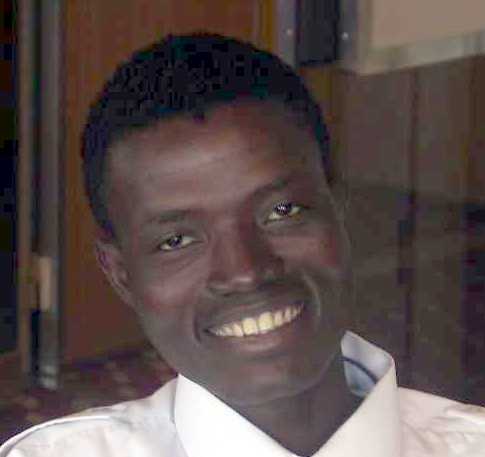
We note that there are many similarities here with the story of Alain Hakizmana (above). We also note that not everyone was sympathetic to Isaac’s case… This letter was sent to the newspaper the following week:
Commit a serious criminal act and get your beaming mug shot featured on the front page of the St Helena Herald with the accompanying unverified potted personal history. Another stowaway on the RMS, another one treated as some sort of hero. The St Helena immigration authorities were wise to refuse to let him land. Lets hope the UK authorities show the same resolve if he is not to become yet another of the great unwanted and uninvited who are the cause of so much consternation amongst large swathes of the electorates in the countries of the European Union. As for the RMS, perhaps its management should invest in a sniffer dog whose upkeep would work out cheaper than the hospitality lavished on stowaways.{d}
From the newspaper, June 2010
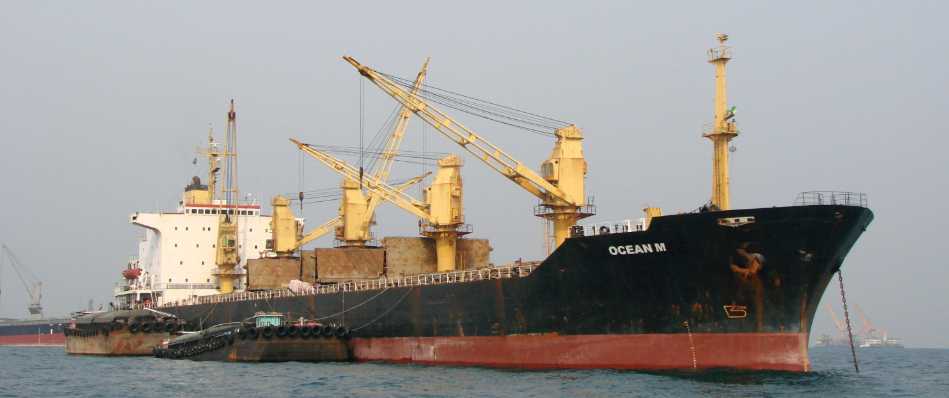
Ship Ocean M
Stowaway Returned
On Tuesday the St Helena Immigration authorities were contacted by a ship called the ‘
{e}Ocean M’, a 40,000 tonne cargo ship on her way to St Helena. The Immigration authorities were told that Ocean M had one stowaway onboard from the port of Mutadi in the Democratic Republic of Congo. After consideration, the request from the Ocean M was turned down and they were told that St Helena could not harbour the stowaway. Late Tuesday afternoon, Peter Coll, the Chief of Police, said that the Ocean M had turned back to the port of Motarde to put the stowaway ashore. The last two stowaways in St Helena were also from the port of Mutadi.
From The Records
The Congo Pair
This from the official report:
Police received a call from a lady at Blue Hill reporting that 2 unknown men are in her back yard. She said they had walked up the hill from the Sandy Bay area. They did not speak English. One was wounded. Upon investigation and through sign language the police determined that they were stowaways from the Congo who were put off a ship onto a raft in the open sea. They drifted for five days and found land at Sandy Bay Beach. Police took them into custody because they were illegal immigrants. They were not brought to trial. They were kept in custody from December until one was deported in February and the other in May due to ship availability.
These two also had an interesting experience with Saint English…
From The ‘Blue Book’
1940s/50s
Stowaways - or, possibly, the same stowaway (the records do not give names) - are listed in The ‘Blue Book’ for 1947, 1948, 1949, 1950-51 and 1952-53.
Others
Some thought the Moncat had arrived here as a stowaway during the Building St Helena Airport project, but as it was never found we will (probably) never know.
The Law
According to the Ports Ordinance 2016: A master of a vessel who permits, suffers or facilitates in any way the landing in St Helena of any person who is or has been a stowaway on the vessel, without the permission in writing of the Governor, commits an offence. Penalty: A fine of £10,000 or imprisonment for 12 months, or both, in respect of each person who was a stowaway on the vessel.. As far as we can find, no master of a vessel has ever been prosecuted for this.
Religion
In case it matters, Francis of Assisi is Christianity’s Patron Saint of Stowaways.
Read More
Article: Stowaway Gecko
By Eira Stevens, published in The Sentinel 6th August 2015
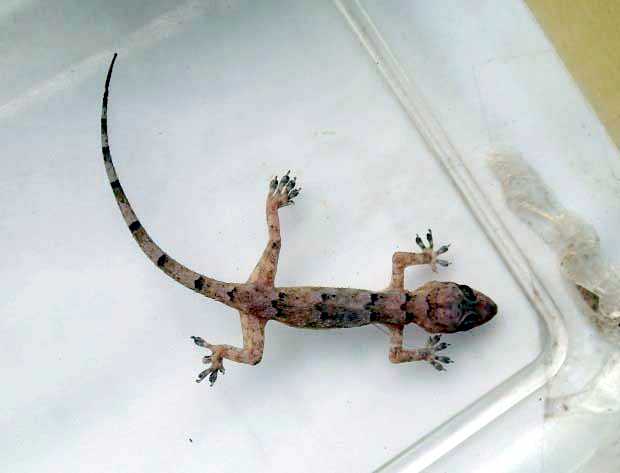
A small reptilian stowaway was recently caught inside a shipping container which arrived from Ascension Island. Whilst offloading hold baggage at the wharf in Jamestown workers found a live gecko among the baggage. The gecko (a small lizard) was caught by worker Peter Corker who passed it onto Customs and then to the Biosecurity team.
From just one glance at the creature, Senior Veterinary Officer Joe Hollins, identified that the gecko was different to those found on St Helena.
Jill Key, Biosecurity Officer told SAMS, Here on island we have Asian House geckos and looking at the two from photos, they both looked completely different. It was confirmed by international experts that the gecko was an Afro-American Gecko which originates from Africa, however it also resides in America and the Caribbean.
Different species of Geckos pose a potential threat to St Helena’s biodiversity and are known to eat invertebrates, many of which are unique to the island. Shipping containers are well known to carry new species around the world and Biosecurity believes it’s very important to stop a new species spreading before it harms our ecosystem.
Joe Hollins said, Finding a live gecko is only one step away from finding a live snake, and we definitely don’t want one of these on the Island. We are very grateful to the workers on the Wharf for their quick action in noticing and catching this animal.
Once the Afro-American gecko was identified it was humanly euthanized and it is now preserved as a specimen.
The public is advised that if any unfamiliar plant, insect or animal is spotted please call the Biosecurity Team at ANRD.

Credits:
{a} Buzz Lightyear in Buzz Lightyear of Star Command: The Adventure Begins{b} Radio St Helena/Museum of St Helena, digitised by Burgh House Media Productions{c} St Helena Herald, 26th July 2002{4}{d} Name withheld in case the author has, in the intervening years, discovered some humanity., {4}{e} The Independent, 18th June 2010{4}
Footnotes:
{1} With the RMS St Helena (1990-2018).{2} With the RMS St Helena (1978-1990).{3} Seven days, usually.{4} @@RepDis@@