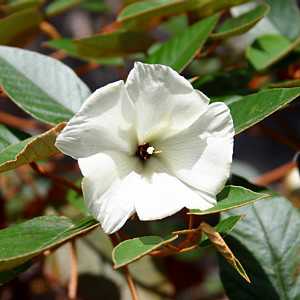

The Flora of St Helena
Pretty Maids all in a row
Mary, Mary, quite contrary, how does your garden grow? With silver bells, and cockle shells, and pretty maids all in a row.{n}
⏱ QUICK READ
The Flora of St Helena is diverse, and includes many endemic species, mostly endangered. There are also many introduced plants, some of which have subsequently been discovered to be invasive and a threat to the endemic flora. On this page we introduce St Helena’s spectacularly varied flora.
SEE ALSO: The other part of the ‘biota’{4} is here: The Fauna of St Helena. Our page Island Nature indexes all the pages that discuss our natural world.
Three Regions
There are three major vegetation zones on St Helena:
In the highest parts of the central ridge (‘The Peaks’) the climate is wetter and cooler. This is mostly now populated with Endemic Species, following years of conservation work by the Government of St Helena and St Helena National Trust.
The middle elevations, where the climate is still fairly wet and a little warmer, were originally covered with native woodland containing Endemic Species. These were largely destroyed in two phases: by the English colonists whose demands for wood and grazing land severely damaged the local ecology, and later by The Flax Industry.
The lower levels, where the climate warm and much drier, are where most people live and most human activity takes place. Here the flora is widely varied, with many introduced species growing well in the sub-tropical climate. There are also some areas of near-desert, with flora to suit. However, much of this land remains ‘barren waste’; the vegetation having been removed the soil was removed by the wind and the rain.
Over recent years considerable effort has been directed into conserving and replanting the original vegetation and controlling the spread of the invasive species. One example is the creation of The Millennium Forest.
Gardens
There are many formal gardens on St Helena which are worth a visit, particularly if you are curious about what can be persuaded to grow in our climate. Some are free to enter; others can only be viewed on a tour (or over the wall!)
Castle Gardens in Jamestown is a stunning floral display and free to enter and enjoy. The gardens at Plantation House are sometimes open to the public, and the surrounding forest is full of introduced species brought (and often planted) by Famous Visitors (the many ecological risks involved were really not understood at the time). Napoleon’s Tomb, Longwood House and The Briars Pavilion also have remarkable gardens filled with interesting plants. The gardens surrounding Farm Lodge Hotel are also worth a visit but the area is private property and a working farm so not easily explored unless you are a resident.
Also, don’t forget to explore our two Arboretums.
Some featured plants
The following is not a catalogue of every flowering plant on St Helena! If you want one of those your best bet is to obtain a copy of Phil Lambdon’ Book ‘Flowering Plants & Ferns of St Helena’ (Pisces Publications, ISBN 978-1-874357-52-0). These are just some we thought might be of particular interest{5}.
Arum Lilies (Zantedeschia_aethiopica) are a spectacular sight in the flowering season, growing wild along the roadsides in the middle elevations.
Jacaranda trees grow well in Jamestown and form a spectacular scenic element against the land and the sea.
Hibiscus is commonly used to create bushes across the lower levels and middle elevations. There is a spectacular display in Castle Gardens.
Ebony flowers{6} are widely grown as a display species, though the best place to see them is ‘in the wild’ at The Millennium Forest.
If you drive along the Middle Elevations in the right season you will see many Nasturtiums growing wild along the roadside.
If you like more unusual plants, go up to The Peaks and spot the Tree Ferns - literally a fern the size of a tree! Other Endemic Species can be found by going up to The Millennium Forest and seeking out the St Helena National Trust growing area (weekdays only).
There are, of course, many Crops grown for food around the island, mostly in Longwood and Blue Hill where the climate and soil are best suited.
More endemic plants are listed on our page Endemic Species.
Here are pictures of some interesting plants that grow around the island, in gardens and other places or even along the roadsides…☺
And also…
{o}
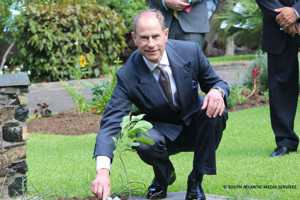
Famous Visitors are sometimes asked to plant an endemic plant in Castle Gardens (HRH Edward, Duke of Edinburgh in 2024, right).
If you have flowers, you also want bees, which fortunately we have, though as bees were introduced here (in the 1930s) all the endemic plants evolved with other methods of pollination. And where there are flowers, there are often butterflies…
Did you know that, when Napoleon got bored during his exile on St Helena he took up gardening?
A lot of our wild plants are not just pretty - they are also edible, some even with (claimed) health-beneficial properties.
Of course, to see our flora in their natural situation you need to take a walk.
Our flora has always been the subject of Photography. Below is one of the earliest colour photographs taken here:
Lastly, if you see something growing wild in the lower levels that you think might be a Cannabis plant it may actually be one! Cannabis will grow wild here.☺ 
Read More
Below: Article: Early History of the Flora & Fauna of St Helena Article: How to spend seven days exploring the nature-filled island of St Helena
Article: Early History of the Flora & Fauna of St Helena
By Dr. Rebecca Cairns-Wicks, published in the St Helena Herald 14th June 2002

Redwood{p}
When St Helena emerged from the sea it was completely free of animal and plant life. The natural communities that developed here were the chance collections of animals and plants, flotsam and jetsam that either flew in, were blown by the wind, or washed up by the sea. As with other remote oceanic islands, the colonising species evolved in isolation from mainland competitors adapting to local conditions and developing into unique species.
Five hundred years ago St Helena would have been a green and fertile island. Perennial streams ran in the valleys and along them grew dense thickets of Ebony. On the rocky slopes were Scrubwoods with their straggly-branched form and daisy like flowers, grey leaved Samphire, Tea plant with its wiry stems and minute leaves and flowers, the gnarled Old Father Live-Forever and the succulent Salad Plant.
At about 400-600 metres above sea level, was gumwood woodland where Gumwood and Bastard Gumwood trees were to be found with their arching branches and clusters of small flowers.
The only mammals to be found were fur seals and possibly elephant seals but birds were plentiful. The island was an important breeding site for seabirds in the South Atlantic and with at least 15 different species of seabird breeding on the Island they would have nested in their millions.
In the uplands (500-650m) where the air was cooler and moist, the Gumwoods gave way to Redwoods tall and majestic, False Gumwoods, She Cabbage trees, ferns and tree ferns. Higher still (700-823m above sea level) along the Island’s central ridge tree ferns were still common but the woodland trees were different Black Cabbage trees, St Helena Olive, Dogwood and Whitewood each unique. The white bell-shaped flowers of the large Bellflower decorated the trunks of the tree ferns, whilst a herb with flowers like a lobelia was common on the forest floor. Fragrant Jellico with its tall thick hollow stems filled the gullies of the ridge.
From early descriptions imagine how the forest looked. Thick stands of Gumwoods covered the Island between 400-600m. The shaded forest floor, littered with the decaying leaves and rich in insect life, was home to the Giant Earwig and Giant Ground beetle. But it was also the domain of the Rail, flightless, they would have foraged amongst the leaves enjoying the bounty of their extraordinarily large prey.
But, the small land area of St Helena and the relatively small numbers of individual species, makes these unique plants, animals and their habitats extraordinarily vulnerable to human disturbance from habitat destruction and modification, introduction of grazing animals and competition from invasive species. With the result that in a very short time, within 100 years of settlement, many of these unique plants and animals had either been completely destroyed or made extremely rare. The scarred eroded hills that characterise the island today are a result of human actions over the last 500 years.
Article: How to spend seven days exploring the nature-filled island of St Helena
By Emma Thompson, published on www.nationalgeographic.co.uk, 8th November 2022
Moments of seclusion, vast stretches of lush landscapes and wildlife found nowhere else on the planet all go hand in hand in St Helena. Here’s how to spend a week making the most of this South Atlantic island.
An emerald fleck floating in the blue orbit of the South Atlantic Ocean, St Helena is one of the most isolated islands on Earth and serves up an unmatchable mix of raw nature and a laidback dose of old-style Britannia. Finally unlocked after the pandemic, the British Territory offers that rare thing: a chance to remember the sweet silence of life without the tring of mobile phones and glare of white screens. A place where keys are left in car ignitions, the dramas of rolling 24/7 news seem a world away and people still greet each other in the street. A place where days can be spent tracing rugged walking trails, meeting the world’s oldest living land creature and snorkelling with leviathans. A stress-free escape where even the locals - the descendants of settlers, soldiers and slaves - are nicknamed ‘Saints.’ Come to unplug and reconnect with wildlife found nowhere else on the planet.
Day one-two: hiking and walking
Criss-crossing the island’s mist-laced peaks and fields of swaying flax are 11 footpaths and 21 Post Box Walks, each of which concludes with a box containing a collectable ink stamp that visitors like to mark in small notebooks. Distances range from a gentle one-mile stroll to a 3.5-hour, seven-mile hike. Favourites include ascending though the cloud forest to Diana’s Peak, St Helena’s highest point, or the challenging trek out to The Barn, a volcanic bluff. Other unmissables are the Heart Shaped Waterfall, Longwood’s rainbow-hued hills and the phallic wind-hewn pinnacle known saucily as Lot’s Wife. Alternatively, pit your calves and lungs against Jacob’s Ladder, a flight of 699 steps - nicknamed after the biblical stairway to heaven - scaling the western slope of Jamestown’s deep valley and all that remains of a cable railway built in the 1800s.
Day three: endemic wildlife
Ever since St Helena erupted from the sea some 13 million years ago, it’s been totally isolated and as such is home to more than 500 species found nowhere else on Earth. Peel back ferns and study black cabbage trees on Diana’s Peak to spot blushing snails and golden sails - one of 22 endemic types of spider. Spy the long-limbed endangered St Helena plover, or wirebird - the island’s only surviving endemic land bird - emerging from burrows amid the dry pastures of Deadwood Plain, and meet the world’s oldest living land animal, Jonathan, a 190-year-old Seychelles giant tortoise who’s grazed the grounds surrounding Plantation House, the governor’s residence, since 1882.
Day four: culture and cuisine
Here, friendliness is a vital part of island life. Drivers wave to every car that passes and islanders send messages to each other via SaintFM. Their seclusion brings quirks, too. Stroll down Jamestown’s high street and you’ll hear musical ‘Saint speak,’ a South Atlantic English patois where locals don’t ask ‘How are you?’ but rather ‘Wa now you awrigh?’ Isolation has inspired invention. When food imports are delayed, Saints have learned to rustle up unique local delicacies. Try the beloved bread and dance, tomato-paste sandwich, and comforting plo, a one-pot curried meat, vegetable and rice dish. Locals also grow and brew the world’s most remote coffee - keep an eye out for the Midnight Mist Coffee Liqueur, made with beans grown on the island.
Day five: Napoleon
Trace the final years of St Helena’s most infamous resident: French emperor Napoleon Bonaparte. Exiled here in 1815 by the British government following his defeat at Waterloo, Napoleon spent his days under house arrest inside elegant Longwood House, in the eastern inlands, until he drew his last breath in 1821. Rumour has it his demise was hastened by the house’s arsenic-laced green wallpaper. Afterwards, a farmer used the emperor’s bedroom to house sheep, but the property was sold back to the French government in 1858 and subsequently restored. Visit the gardens he designed, the billiards table he spread maps on and his canopy-cloaked bedroom. Nearby, stands his modest iron railing-guarded tomb.
Day six: underwater adventures
Book with either Dive Saint Helena or Sub-Tropic Adventures and submerge yourself in the fecund waters surrounding the island. St Helena’s volcanic base pushes up a lifeline of nutrients from the deep, attracting a riot of marine life. Between June and December, migratory humpback whales pass through, pausing to calve in July. Visitors also include bottlenose, pantropical spotted and rough-toothed dolphins as well as green and hawksbill turtles, while the rocky, wreck-strewn reefs shelter 10 species of endemic fish, including the bastard fivefinger and St Helena dragonet.
Day seven: Dark Skies
Come nightfall, lay beneath St Helena’s incredibly sparkly skies. More than 1,000 miles from the nearest major landmass and with a total of just 4,400 inhabitants, there’s virtually zero light pollution and the island’s location near the Equator means constellations belonging to both the northern and southern hemispheres, such as the Plough and the Southern Cross, can be seen. St Helena is in the process of applying for International Dark-Sky Association status and early measurements suggest the island’s night skies are significantly darker than Sark, the first island in the world to be accredited.
More information
For more information, visit sthelenatourism.com
This content is brought to you by St Helena Tourism. It does not necessarily reflect the views of National Geographic, National Geographic Traveller (UK) or its editorial staff.
Our Comment: See our own page What To Do for our Top 20 Things To Do.

Credits:
{a} Domaines Français de Sainte Hélène{b} Île de Sainte-Hélène - Atlantique Sud{c} Copyright © South Atlantic Media Services Ltd. (SAMS), used with permission.{d} Paul Carroll{e} CKW Photography{f} Sasha L Bargo{g} Earth Observatory, taken from the ISS{h} Andrew Turner{i} Ed Thorpe{j} National Geographic Magazine{k} Emma Weaver{l} The BBC.{m} CKW Photography{n} Nursery Rhyme{7}{o} Copyright © South Atlantic Media Services Ltd. (SAMS), used with permission.{p} William John Burchell
Footnotes:
{1} Apparently there were Napoleon’s favourite flowers and he so missed them he persuaded somebody to import some to plant at Longwood House. Of course, they spread. These were photographed in Blue Hill!{2} Not to be confused with Whiteweed,a very invasive species.{3} Fortunately, Teutonic Hall has been restored.{4} A fancy word for ‘nature’.{5} If you have further suggestions please contact us.{6} An Endemic Species not related to the wood-giving tree.{7} Generally understood to refer to Mary, Queen of Scots at the time of her imprisonment by Queen Elizabeth 1st.